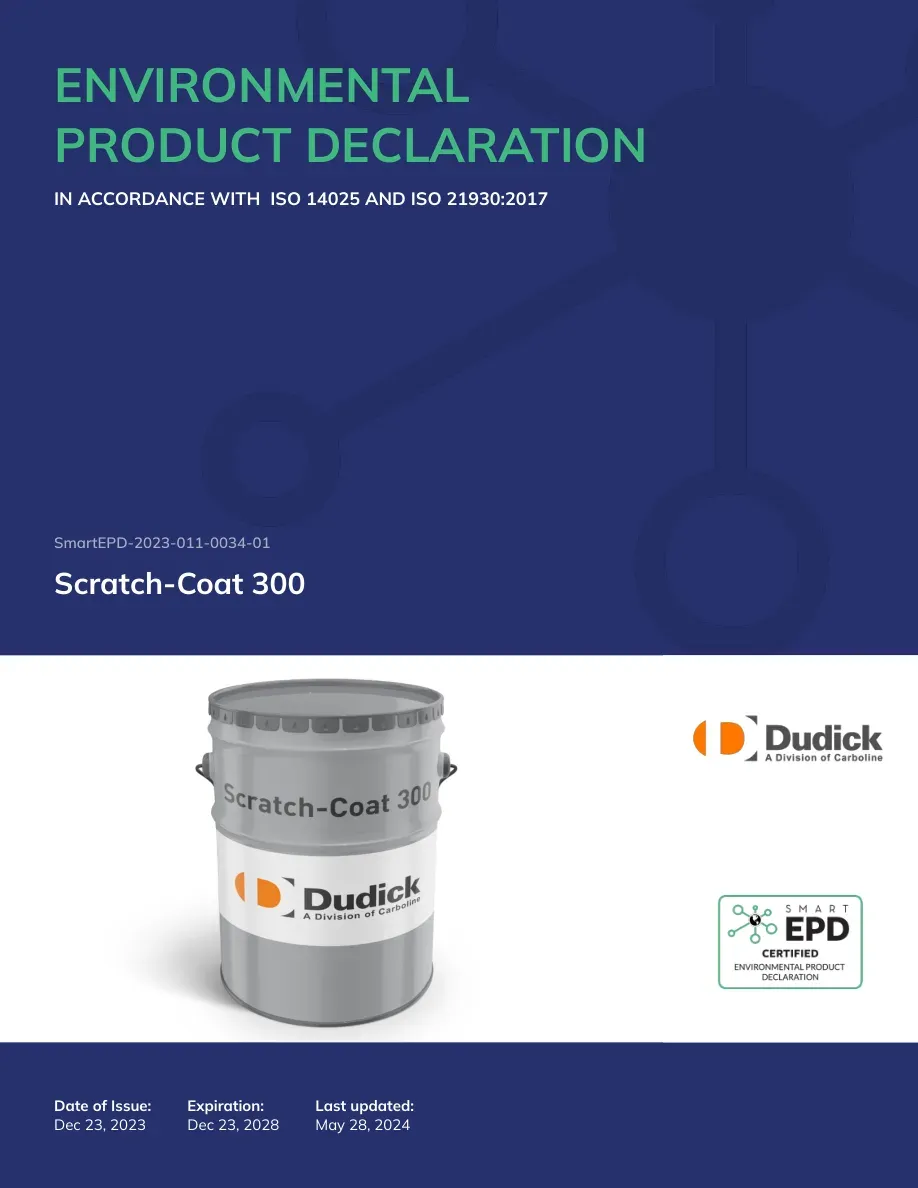
ENVIRONMENTALPRODUCT DECLARATIONIN ACCORDANCE WITH ISO 14025 AND ISO 21930:2017SmartEPD-2023-011-0034-01Scratch-Coat 300Date of Issue:Dec 23, 2023Expiration:Dec 23, 2028Last updated:May 28, 2024
Scratch-Coat 300Dudick Inc.General Information3Reference Standards3Verification Information4Limitations, Liability, and Ownership4Organization Information4Product Information4Plants5Product Specifications5Material Composition5Software and LCI Data Sources6EPD Data Specificity6Renewable Electricity6System Boundary7Product Flow Diagram8Life Cycle Module Descriptions8LCA Discussion8Results10Environmental Impact Assessment10Resource Use Indicators12Waste and output Flow Indicators14Carbon Emissions and Removals15Scenarios16Transport to the building/construction site (A4)16Installation in to the building/construction site (A5)16Reference Service Life (B1)16Maintenance (B2)17Page 2 / 20
Scratch-Coat 300Dudick Inc.Replacement (B4)17End of Life (C1 - C4)17Interpretation17Additional Environmental Information19References19Page 3 / 20
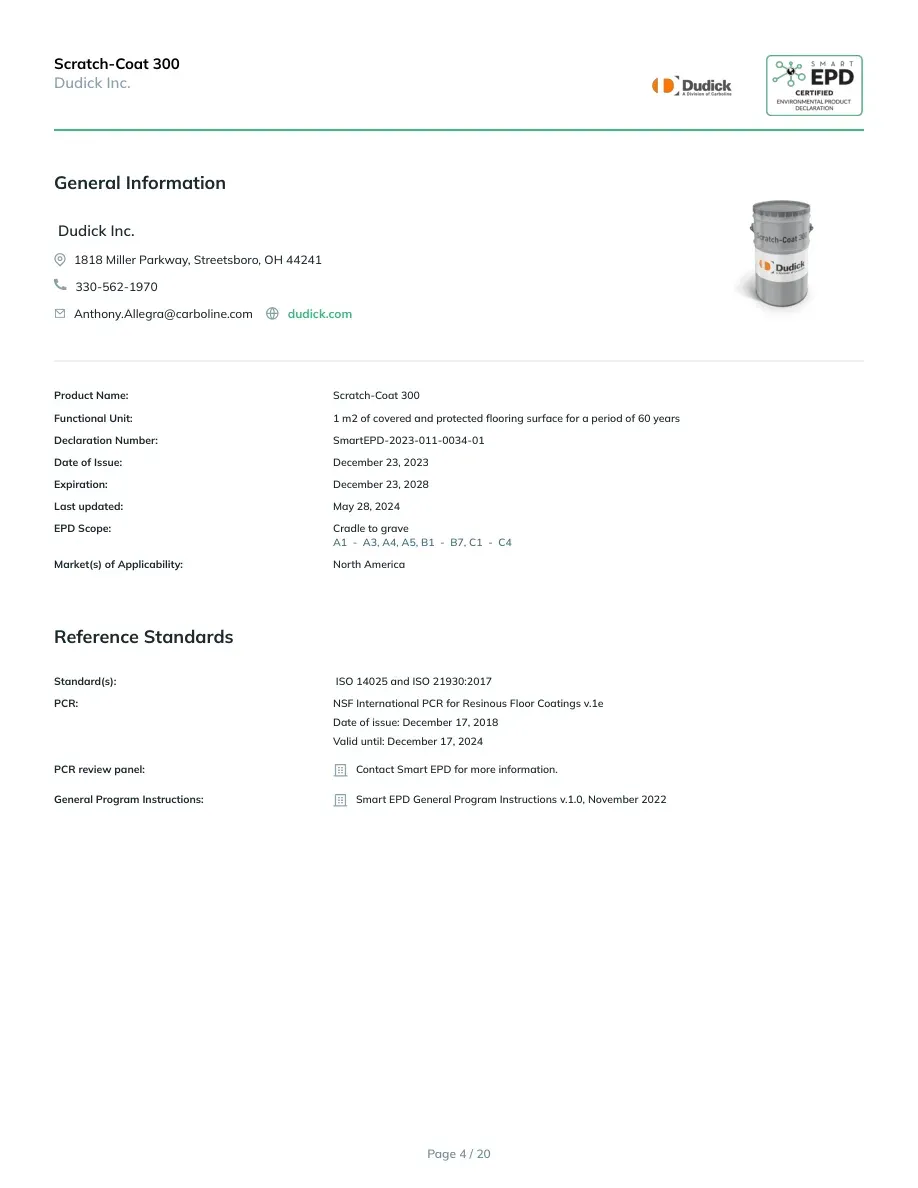
Scratch-Coat 300Dudick Inc.General Information Dudick Inc. 1818 Miller Parkway, Streetsboro, OH 44241330-562-1970Anthony.Allegra@carboline.comdudick.comProduct Name:Scratch-Coat 300Functional Unit:1 m2 of covered and protected flooring surface for a period of 60 yearsDeclaration Number:SmartEPD-2023-011-0034-01Date of Issue:December 23, 2023Expiration:December 23, 2028Last updated:May 28, 2024EPD Scope:Cradle to graveA1 - A3, A4, A5, B1 - B7, C1 - C4 Market(s) of Applicability:North AmericaReference StandardsStandard(s): ISO 14025 and ISO 21930:2017PCR:NSF International PCR for Resinous Floor Coatings v.1eDate of issue: December 17, 2018Valid until: December 17, 2024PCR review panel:Contact Smart EPD for more information.General Program Instructions:Smart EPD General Program Instructions v.1.0, November 2022Page 4 / 20
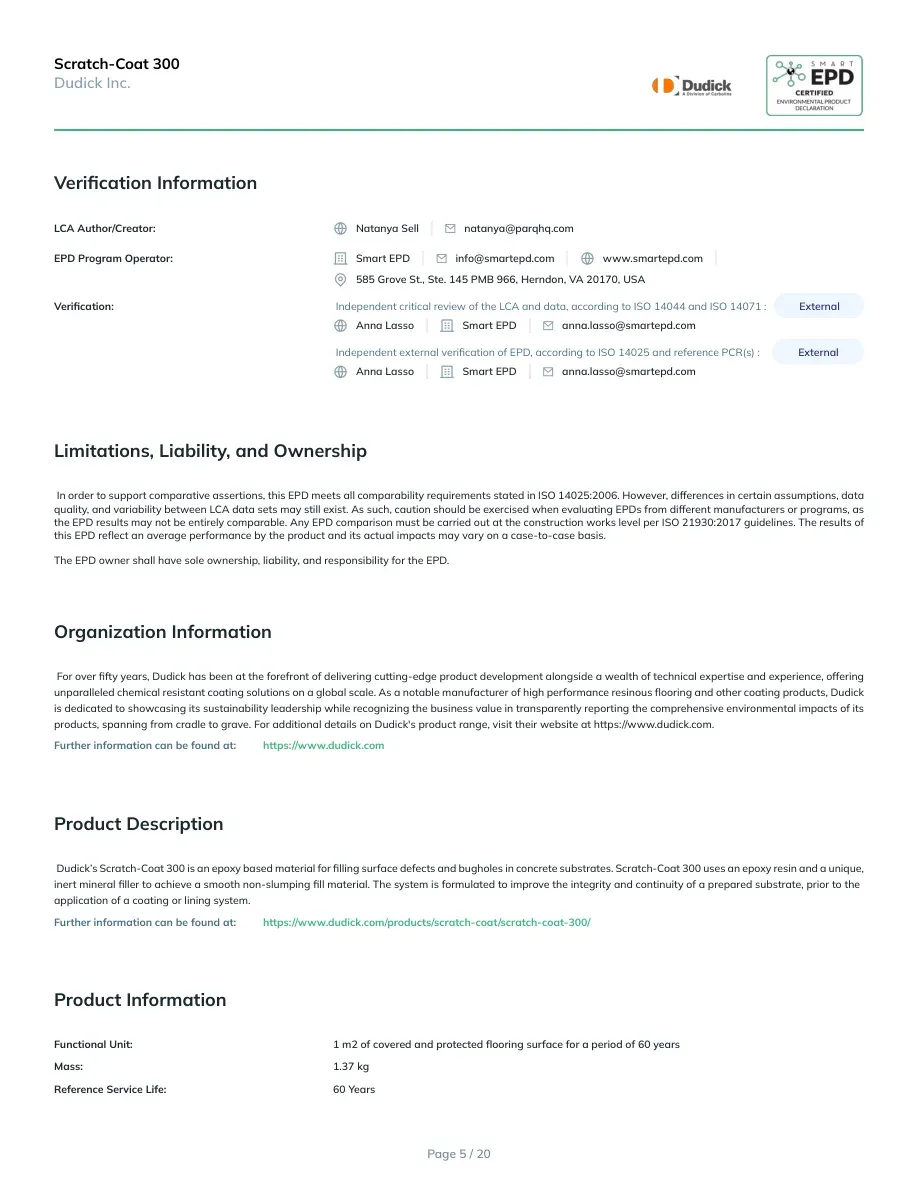
Scratch-Coat 300Dudick Inc.Verification InformationLCA Author/Creator:Natanya Sellnatanya@parqhq.comEPD Program Operator:Smart EPDinfo@smartepd.comwww.smartepd.com585 Grove St., Ste. 145 PMB 966, Herndon, VA 20170, USAVerification: Independent critical review of the LCA and data, according to ISO 14044 and ISO 14071 : External Anna LassoSmart EPDanna.lasso@smartepd.com Independent external verification of EPD, according to ISO 14025 and reference PCR(s) : External Anna LassoSmart EPDanna.lasso@smartepd.comLimitations, Liability, and Ownership In order to support comparative assertions, this EPD meets all comparability requirements stated in ISO 14025:2006. However, differences in certain assumptions, data quality, and variability between LCA data sets may still exist. As such, caution should be exercised when evaluating EPDs from different manufacturers or programs, as the EPD results may not be entirely comparable. Any EPD comparison must be carried out at the construction works level per ISO 21930:2017 guidelines. The results of this EPD reflect an average performance by the product and its actual impacts may vary on a case-to-case basis. The EPD owner shall have sole ownership, liability, and responsibility for the EPD. Organization Information For over fifty years, Dudick has been at the forefront of delivering cutting-edge product development alongside a wealth of technical expertise and experience, offering unparalleled chemical resistant coating solutions on a global scale. As a notable manufacturer of high performance resinous flooring and other coating products, Dudick is dedicated to showcasing its sustainability leadership while recognizing the business value in transparently reporting the comprehensive environmental impacts of its products, spanning from cradle to grave. For additional details on Dudick's product range, visit their website at https://www.dudick.com. Further information can be found at:https://www.dudick.comProduct Description Dudick’s Scratch-Coat 300 is an epoxy based material for filling surface defects and bugholes in concrete substrates. Scratch-Coat 300 uses an epoxy resin and a unique, inert mineral filler to achieve a smooth non-slumping fill material. The system is formulated to improve the integrity and continuity of a prepared substrate, prior to the application of a coating or lining system. Further information can be found at:https://www.dudick.com/products/scratch-coat/scratch-coat-300/Product InformationFunctional Unit:1 m2 of covered and protected flooring surface for a period of 60 yearsMass:1.37 kgReference Service Life:60 YearsPage 5 / 20
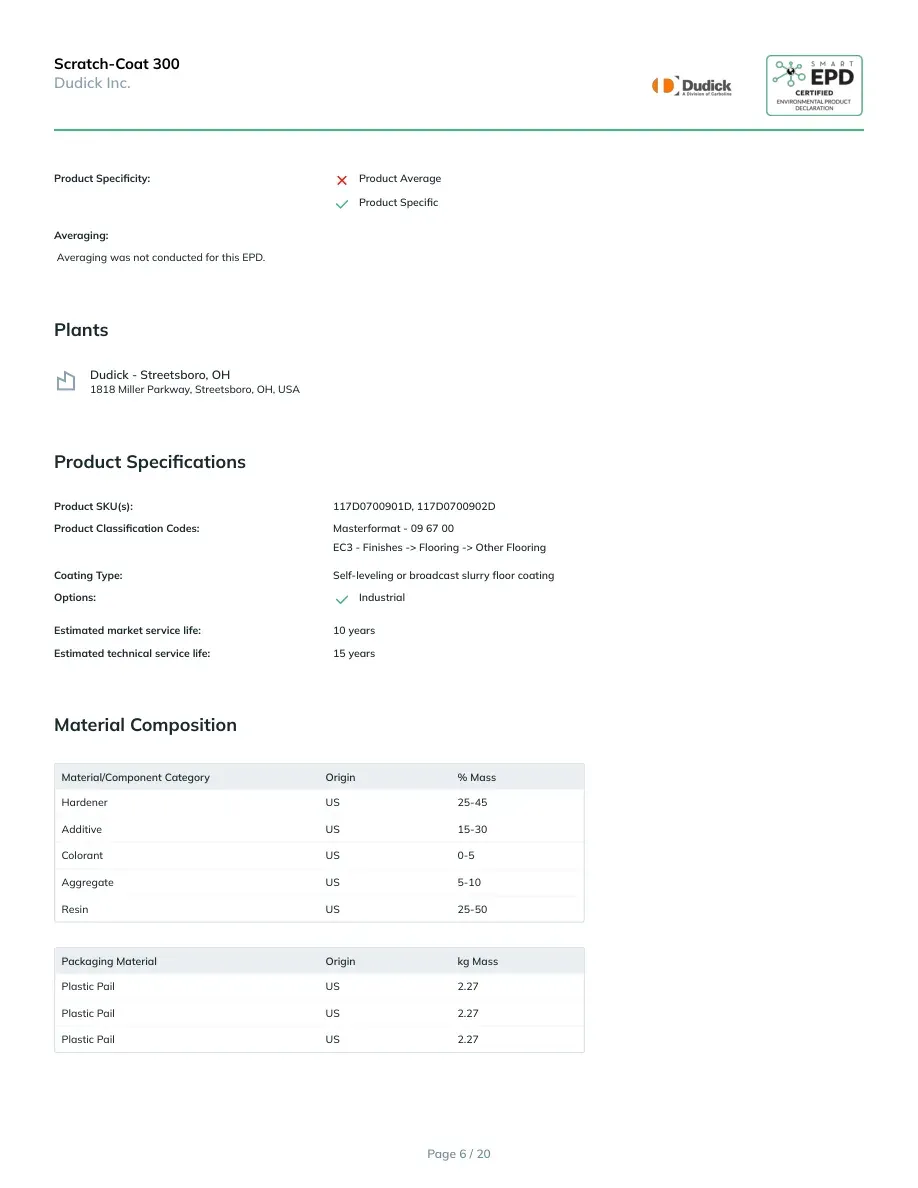
Scratch-Coat 300Dudick Inc.Product Specificity:Product AverageProduct SpecificAveraging: Averaging was not conducted for this EPD. PlantsDudick - Streetsboro, OH1818 Miller Parkway, Streetsboro, OH, USAProduct SpecificationsProduct SKU(s):117D0700901D, 117D0700902DProduct Classification Codes:Masterformat - 09 67 00EC3 - Finishes -> Flooring -> Other FlooringCoating Type:Self-leveling or broadcast slurry floor coatingOptions:IndustrialEstimated market service life:10 yearsEstimated technical service life:15 yearsMaterial CompositionMaterial/Component CategoryOrigin% MassHardenerUS25-45AdditiveUS15-30ColorantUS0-5AggregateUS5-10ResinUS25-50Packaging MaterialOriginkg MassPlastic PailUS2.27Plastic PailUS2.27Plastic PailUS2.27Page 6 / 20
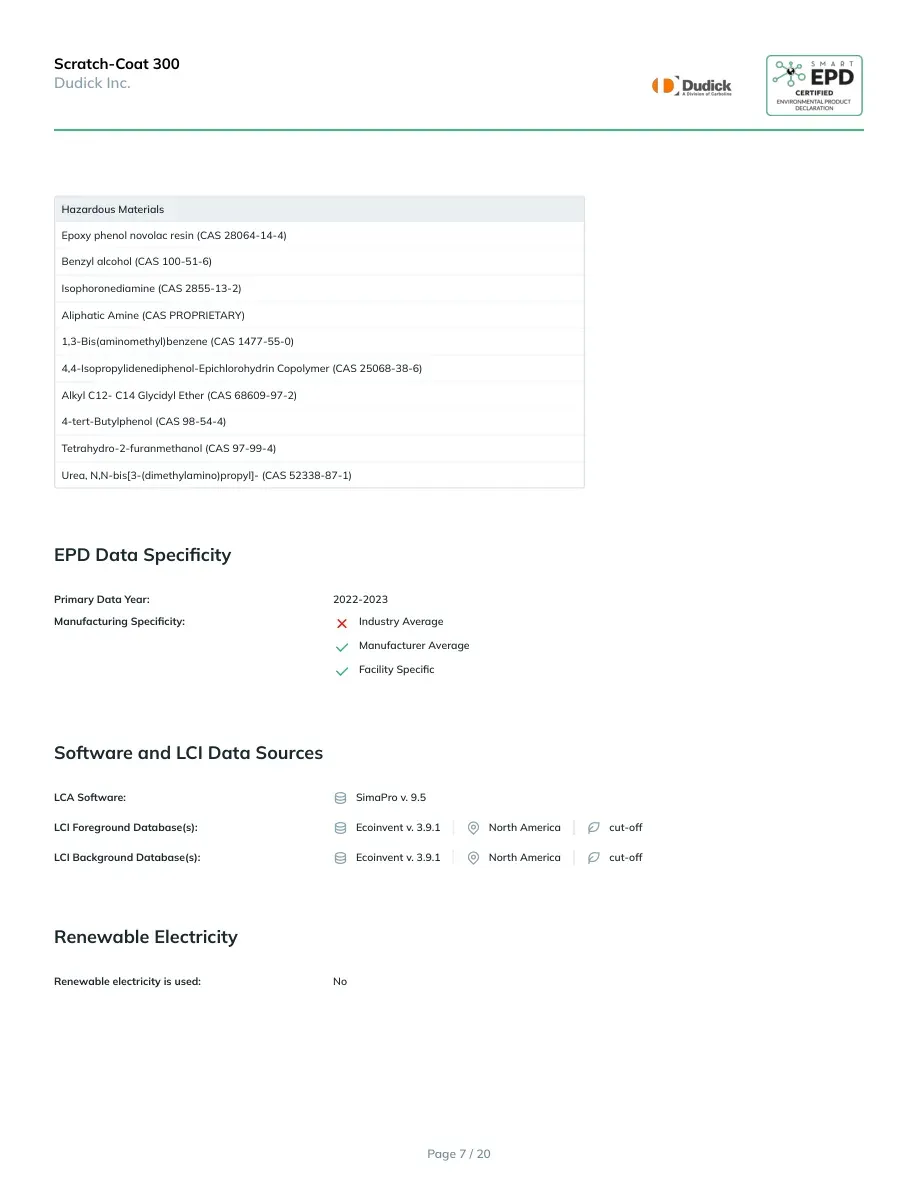
Scratch-Coat 300Dudick Inc.Hazardous MaterialsEpoxy phenol novolac resin (CAS 28064-14-4)Benzyl alcohol (CAS 100-51-6)Isophoronediamine (CAS 2855-13-2)Aliphatic Amine (CAS PROPRIETARY)1,3-Bis(aminomethyl)benzene (CAS 1477-55-0)4,4-Isopropylidenediphenol-Epichlorohydrin Copolymer (CAS 25068-38-6)Alkyl C12- C14 Glycidyl Ether (CAS 68609-97-2)4-tert-Butylphenol (CAS 98-54-4)Tetrahydro-2-furanmethanol (CAS 97-99-4)Urea, N,N-bis[3-(dimethylamino)propyl]- (CAS 52338-87-1)EPD Data SpecificityPrimary Data Year:2022-2023Manufacturing Specificity:Industry AverageManufacturer AverageFacility SpecificSoftware and LCI Data SourcesLCA Software:SimaPro v. 9.5LCI Foreground Database(s):Ecoinvent v. 3.9.1North Americacut-offLCI Background Database(s):Ecoinvent v. 3.9.1North Americacut-offRenewable ElectricityRenewable electricity is used:NoPage 7 / 20
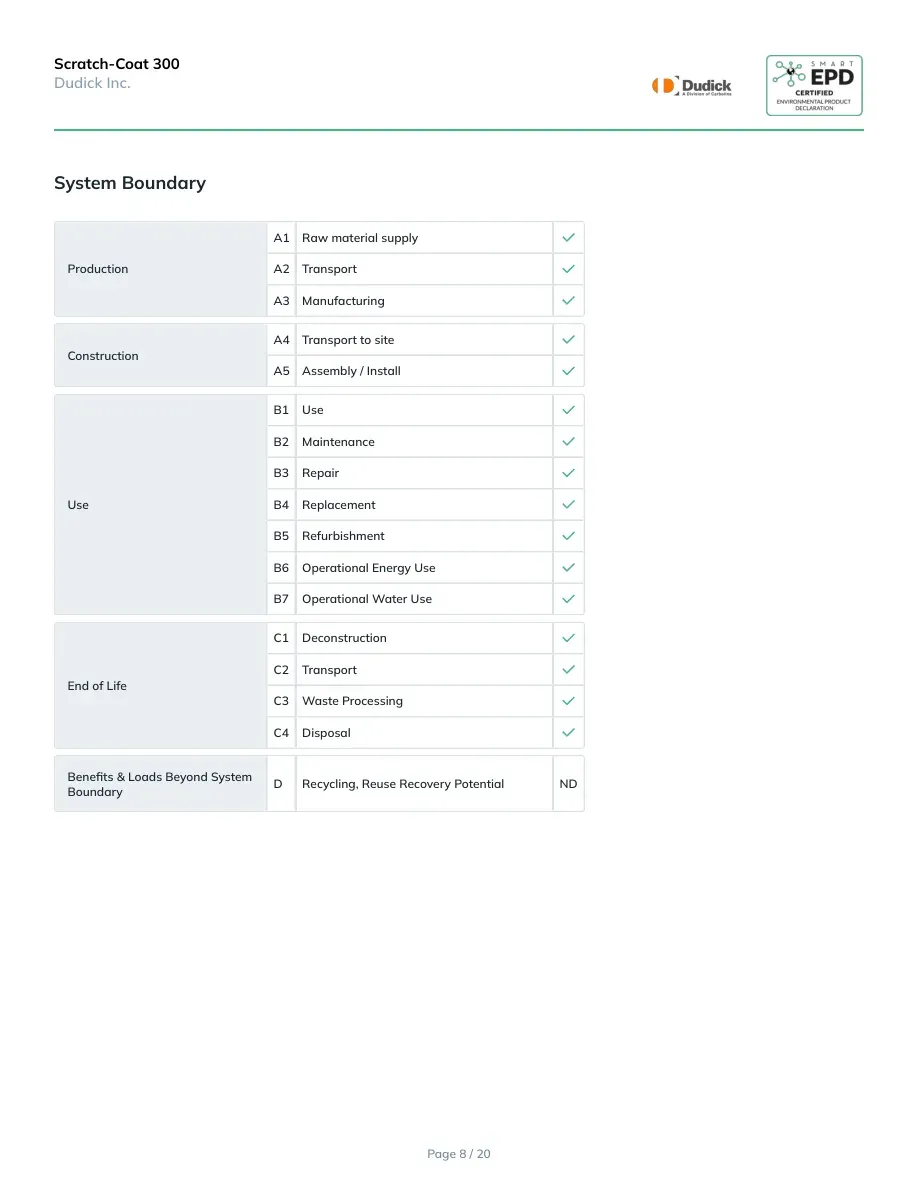
Scratch-Coat 300Dudick Inc.System BoundaryProductionA1Raw material supplyA2TransportA3ManufacturingConstructionA4Transport to siteA5Assembly / InstallUseB1UseB2MaintenanceB3RepairB4ReplacementB5RefurbishmentB6Operational Energy UseB7Operational Water UseEnd of LifeC1DeconstructionC2TransportC3Waste ProcessingC4DisposalBenefits & Loads Beyond System BoundaryDRecycling, Reuse Recovery PotentialNDPage 8 / 20
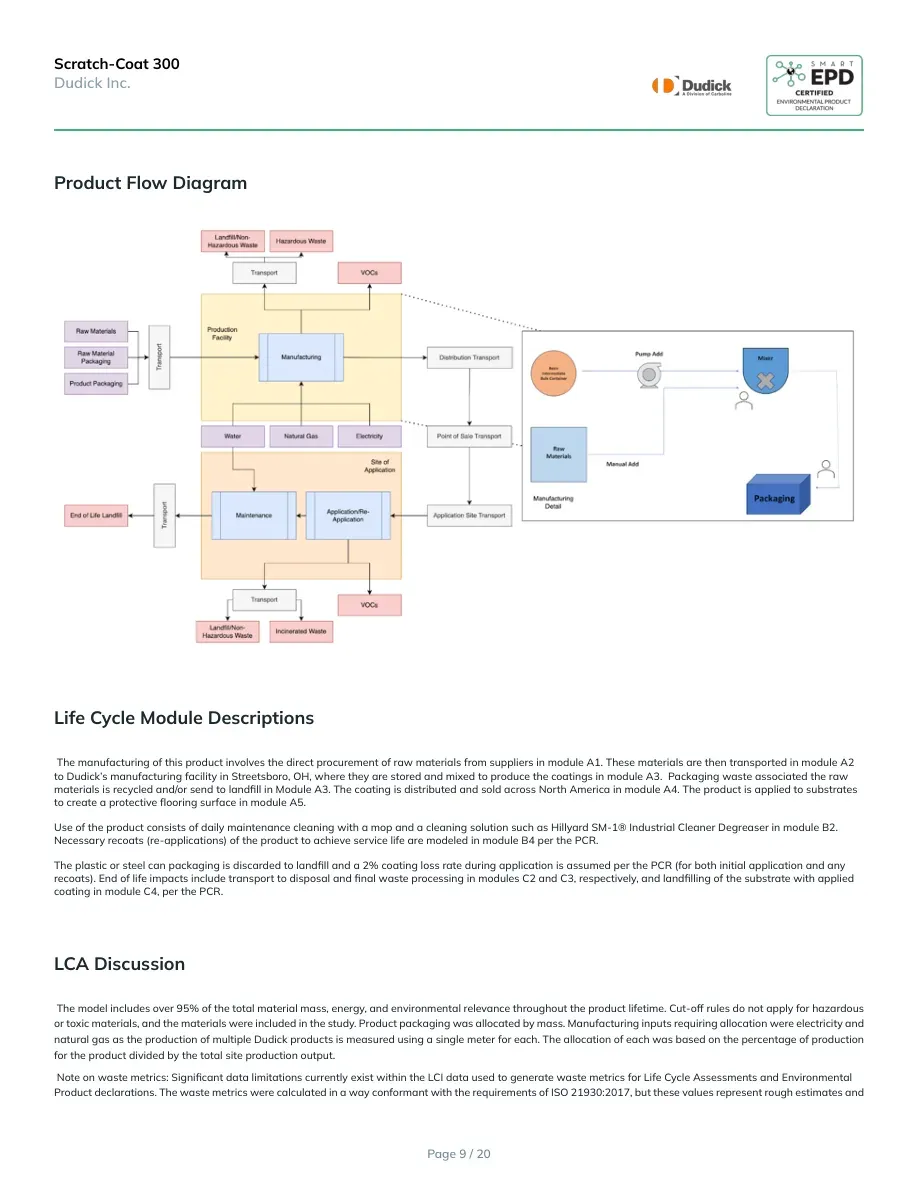
Scratch-Coat 300Dudick Inc.Product Flow DiagramLife Cycle Module Descriptions The manufacturing of this product involves the direct procurement of raw materials from suppliers in module A1. These materials are then transported in module A2 to Dudick’s manufacturing facility in Streetsboro, OH, where they are stored and mixed to produce the coatings in module A3. Packaging waste associated the raw materials is recycled and/or send to landfill in Module A3. The coating is distributed and sold across North America in module A4. The product is applied to substrates to create a protective flooring surface in module A5.Use of the product consists of daily maintenance cleaning with a mop and a cleaning solution such as Hillyard SM-1® Industrial Cleaner Degreaser in module B2. Necessary recoats (re-applications) of the product to achieve service life are modeled in module B4 per the PCR. The plastic or steel can packaging is discarded to landfill and a 2% coating loss rate during application is assumed per the PCR (for both initial application and any recoats). End of life impacts include transport to disposal and final waste processing in modules C2 and C3, respectively, and landfilling of the substrate with applied coating in module C4, per the PCR. LCA Discussion The model includes over 95% of the total material mass, energy, and environmental relevance throughout the product lifetime. Cut-off rules do not apply for hazardous or toxic materials, and the materials were included in the study. Product packaging was allocated by mass. Manufacturing inputs requiring allocation were electricity and natural gas as the production of multiple Dudick products is measured using a single meter for each. The allocation of each was based on the percentage of production for the product divided by the total site production output. Note on waste metrics: Significant data limitations currently exist within the LCI data used to generate waste metrics for Life Cycle Assessments and Environmental Product declarations. The waste metrics were calculated in a way conformant with the requirements of ISO 21930:2017, but these values represent rough estimates and Page 9 / 20

Scratch-Coat 300Dudick Inc.are for informational purposes only. As such, no decisions regarding actual cradle-grave waste performance between products should be derived from these reported values. Page 10 / 20
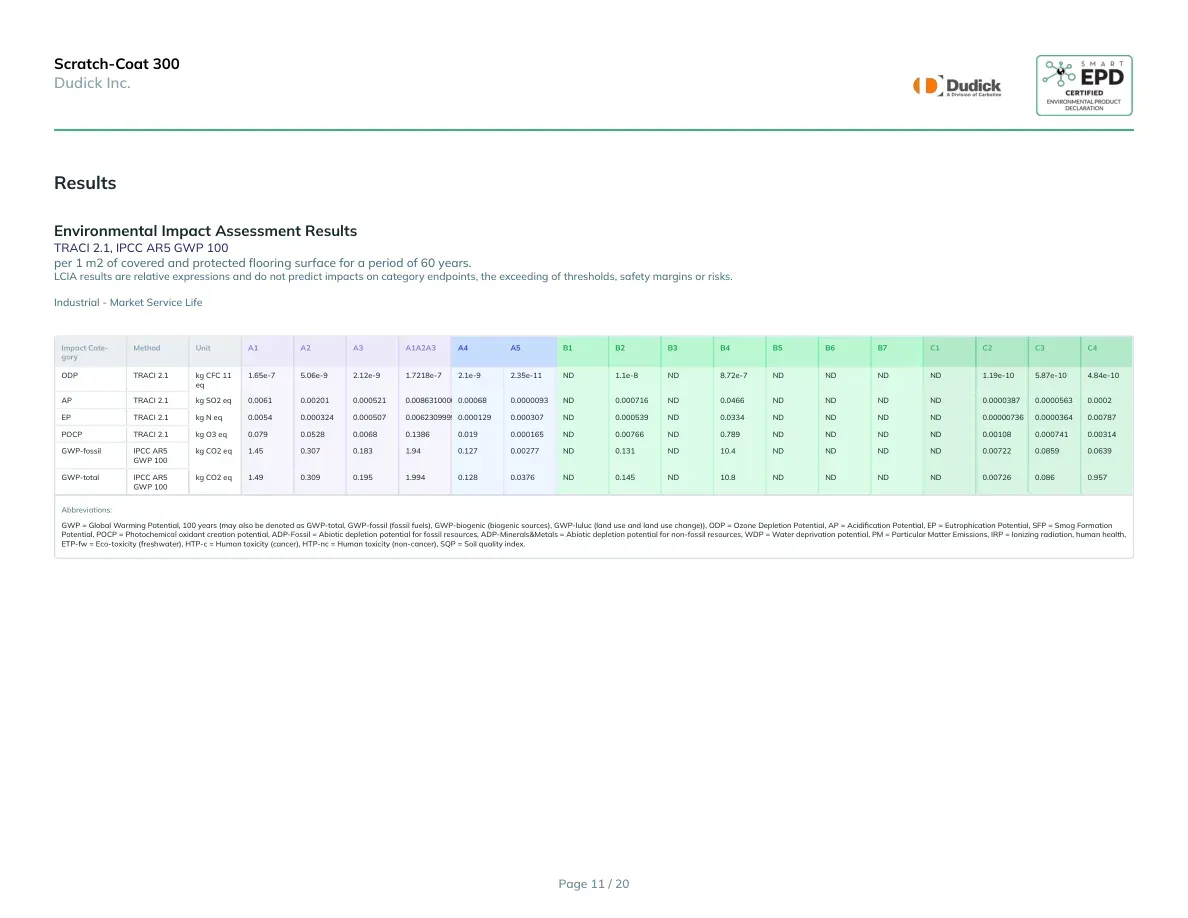
Scratch-Coat 300Dudick Inc.ResultsEnvironmental Impact Assessment ResultsTRACI 2.1, IPCC AR5 GWP 100per 1 m2 of covered and protected flooring surface for a period of 60 years.LCIA results are relative expressions and do not predict impacts on category endpoints, the exceeding of thresholds, safety margins or risks.Industrial - Market Service LifeImpact Cate-goryMethodUnitA1A2A3A1A2A3A4A5B1B2B3B4B5B6B7C1C2C3C4ODPTRACI 2.1kg CFC 11 eq1.65e-75.06e-92.12e-91.7218e-72.1e-92.35e-11ND1.1e-8ND8.72e-7NDNDNDND1.19e-105.87e-104.84e-10APTRACI 2.1kg SO2 eq0.00610.002010.0005210.0086310000000000020.000680.0000093ND0.000716ND0.0466NDNDNDND0.00003870.00005630.0002EPTRACI 2.1kg N eq0.00540.0003240.0005070.00623099999999999960.0001290.000307ND0.000539ND0.0334NDNDNDND0.000007360.00003640.00787POCPTRACI 2.1kg O3 eq0.0790.05280.00680.13860.0190.000165ND0.00766ND0.789NDNDNDND0.001080.0007410.00314GWP-fossilIPCC AR5 GWP 100kg CO2 eq1.450.3070.1831.940.1270.00277ND0.131ND10.4NDNDNDND0.007220.08590.0639GWP-totalIPCC AR5 GWP 100kg CO2 eq1.490.3090.1951.9940.1280.0376ND0.145ND10.8NDNDNDND0.007260.0860.957Abbreviations:GWP = Global Warming Potential, 100 years (may also be denoted as GWP-total, GWP-fossil (fossil fuels), GWP-biogenic (biogenic sources), GWP-luluc (land use and land use change)), ODP = Ozone Depletion Potential, AP = Acidification Potential, EP = Eutrophication Potential, SFP = Smog Formation Potential, POCP = Photochemical oxidant creation potential, ADP-Fossil = Abiotic depletion potential for fossil resources, ADP-Minerals&Metals = Abiotic depletion potential for non-fossil resources, WDP = Water deprivation potential, PM = Particular Matter Emissions, IRP = Ionizing radiation, human health, ETP-fw = Eco-toxicity (freshwater), HTP-c = Human toxicity (cancer), HTP-nc = Human toxicity (non-cancer), SQP = Soil quality index.Page 11 / 20
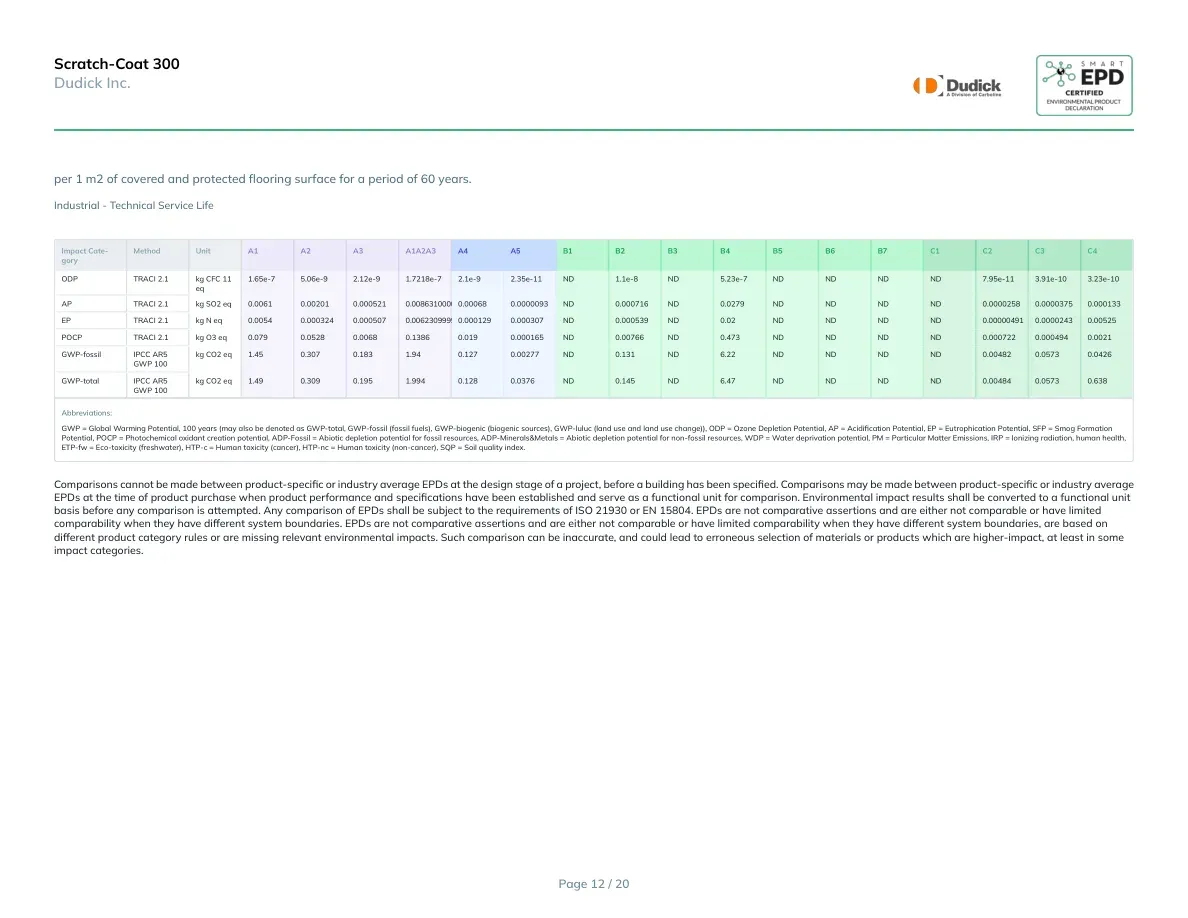
Scratch-Coat 300Dudick Inc.per 1 m2 of covered and protected flooring surface for a period of 60 years.Industrial - Technical Service LifeImpact Cate-goryMethodUnitA1A2A3A1A2A3A4A5B1B2B3B4B5B6B7C1C2C3C4ODPTRACI 2.1kg CFC 11 eq1.65e-75.06e-92.12e-91.7218e-72.1e-92.35e-11ND1.1e-8ND5.23e-7NDNDNDND7.95e-113.91e-103.23e-10APTRACI 2.1kg SO2 eq0.00610.002010.0005210.0086310000000000020.000680.0000093ND0.000716ND0.0279NDNDNDND0.00002580.00003750.000133EPTRACI 2.1kg N eq0.00540.0003240.0005070.00623099999999999960.0001290.000307ND0.000539ND0.02NDNDNDND0.000004910.00002430.00525POCPTRACI 2.1kg O3 eq0.0790.05280.00680.13860.0190.000165ND0.00766ND0.473NDNDNDND0.0007220.0004940.0021GWP-fossilIPCC AR5 GWP 100kg CO2 eq1.450.3070.1831.940.1270.00277ND0.131ND6.22NDNDNDND0.004820.05730.0426GWP-totalIPCC AR5 GWP 100kg CO2 eq1.490.3090.1951.9940.1280.0376ND0.145ND6.47NDNDNDND0.004840.05730.638Abbreviations:GWP = Global Warming Potential, 100 years (may also be denoted as GWP-total, GWP-fossil (fossil fuels), GWP-biogenic (biogenic sources), GWP-luluc (land use and land use change)), ODP = Ozone Depletion Potential, AP = Acidification Potential, EP = Eutrophication Potential, SFP = Smog Formation Potential, POCP = Photochemical oxidant creation potential, ADP-Fossil = Abiotic depletion potential for fossil resources, ADP-Minerals&Metals = Abiotic depletion potential for non-fossil resources, WDP = Water deprivation potential, PM = Particular Matter Emissions, IRP = Ionizing radiation, human health, ETP-fw = Eco-toxicity (freshwater), HTP-c = Human toxicity (cancer), HTP-nc = Human toxicity (non-cancer), SQP = Soil quality index.Comparisons cannot be made between product-specific or industry average EPDs at the design stage of a project, before a building has been specified. Comparisons may be made between product-specific or industry average EPDs at the time of product purchase when product performance and specifications have been established and serve as a functional unit for comparison. Environmental impact results shall be converted to a functional unit basis before any comparison is attempted. Any comparison of EPDs shall be subject to the requirements of ISO 21930 or EN 15804. EPDs are not comparative assertions and are either not comparable or have limited comparability when they have different system boundaries. EPDs are not comparative assertions and are either not comparable or have limited comparability when they have different system boundaries, are based on different product category rules or are missing relevant environmental impacts. Such comparison can be inaccurate, and could lead to erroneous selection of materials or products which are higher-impact, at least in some impact categories.Page 12 / 20
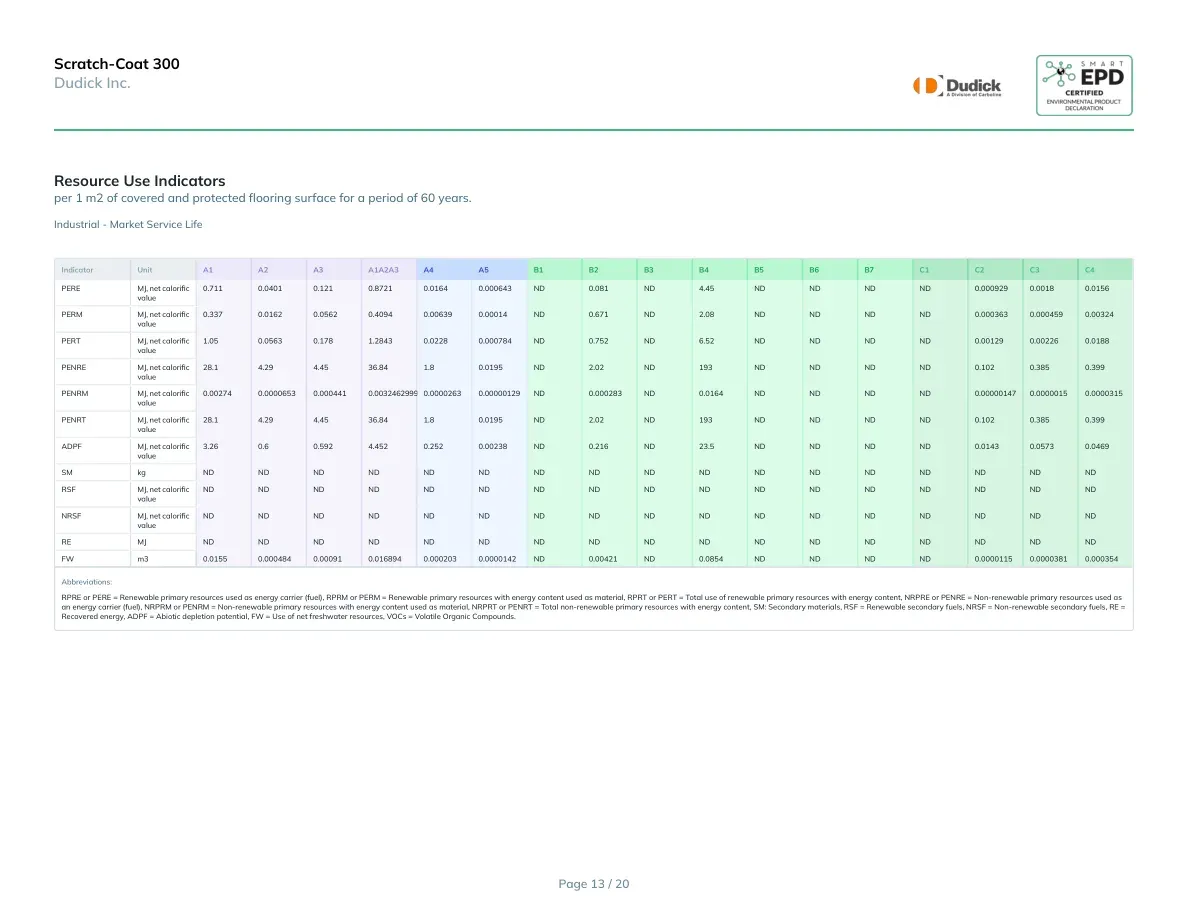
Scratch-Coat 300Dudick Inc.Resource Use Indicatorsper 1 m2 of covered and protected flooring surface for a period of 60 years.Industrial - Market Service LifeIndicatorUnitA1A2A3A1A2A3A4A5B1B2B3B4B5B6B7C1C2C3C4PEREMJ, net calorific value0.7110.04010.1210.87210.01640.000643ND0.081ND4.45NDNDNDND0.0009290.00180.0156PERMMJ, net calorific value0.3370.01620.05620.40940.006390.00014ND0.671ND2.08NDNDNDND0.0003630.0004590.00324PERTMJ, net calorific value1.050.05630.1781.28430.02280.000784ND0.752ND6.52NDNDNDND0.001290.002260.0188PENREMJ, net calorific value28.14.294.4536.841.80.0195ND2.02ND193NDNDNDND0.1020.3850.399PENRMMJ, net calorific value0.002740.00006530.0004410.00324629999999999970.00002630.00000129ND0.000283ND0.0164NDNDNDND0.000001470.00000150.0000315PENRTMJ, net calorific value28.14.294.4536.841.80.0195ND2.02ND193NDNDNDND0.1020.3850.399ADPFMJ, net calorific value3.260.60.5924.4520.2520.00238ND0.216ND23.5NDNDNDND0.01430.05730.0469SMkgNDNDNDNDNDNDNDNDNDNDNDNDNDNDNDNDNDRSFMJ, net calorific valueNDNDNDNDNDNDNDNDNDNDNDNDNDNDNDNDNDNRSFMJ, net calorific valueNDNDNDNDNDNDNDNDNDNDNDNDNDNDNDNDNDREMJNDNDNDNDNDNDNDNDNDNDNDNDNDNDNDNDNDFWm30.01550.0004840.000910.0168940.0002030.0000142ND0.00421ND0.0854NDNDNDND0.00001150.00003810.000354Abbreviations:RPRE or PERE = Renewable primary resources used as energy carrier (fuel), RPRM or PERM = Renewable primary resources with energy content used as material, RPRT or PERT = Total use of renewable primary resources with energy content, NRPRE or PENRE = Non-renewable primary resources used as an energy carrier (fuel), NRPRM or PENRM = Non-renewable primary resources with energy content used as material, NRPRT or PENRT = Total non-renewable primary resources with energy content, SM: Secondary materials, RSF = Renewable secondary fuels, NRSF = Non-renewable secondary fuels, RE = Recovered energy, ADPF = Abiotic depletion potential, FW = Use of net freshwater resources, VOCs = Volatile Organic Compounds.Page 13 / 20
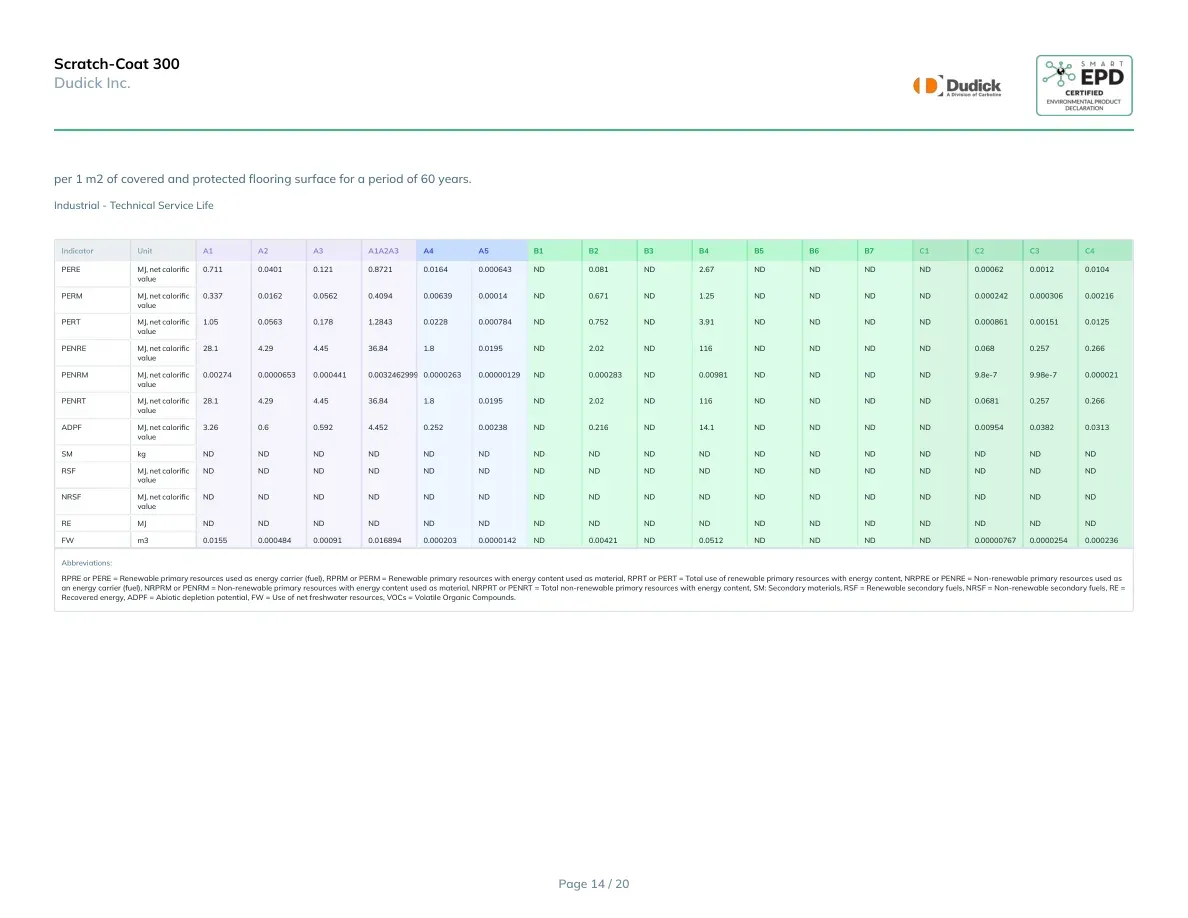
Scratch-Coat 300Dudick Inc.per 1 m2 of covered and protected flooring surface for a period of 60 years.Industrial - Technical Service LifeIndicatorUnitA1A2A3A1A2A3A4A5B1B2B3B4B5B6B7C1C2C3C4PEREMJ, net calorific value0.7110.04010.1210.87210.01640.000643ND0.081ND2.67NDNDNDND0.000620.00120.0104PERMMJ, net calorific value0.3370.01620.05620.40940.006390.00014ND0.671ND1.25NDNDNDND0.0002420.0003060.00216PERTMJ, net calorific value1.050.05630.1781.28430.02280.000784ND0.752ND3.91NDNDNDND0.0008610.001510.0125PENREMJ, net calorific value28.14.294.4536.841.80.0195ND2.02ND116NDNDNDND0.0680.2570.266PENRMMJ, net calorific value0.002740.00006530.0004410.00324629999999999970.00002630.00000129ND0.000283ND0.00981NDNDNDND9.8e-79.98e-70.000021PENRTMJ, net calorific value28.14.294.4536.841.80.0195ND2.02ND116NDNDNDND0.06810.2570.266ADPFMJ, net calorific value3.260.60.5924.4520.2520.00238ND0.216ND14.1NDNDNDND0.009540.03820.0313SMkgNDNDNDNDNDNDNDNDNDNDNDNDNDNDNDNDNDRSFMJ, net calorific valueNDNDNDNDNDNDNDNDNDNDNDNDNDNDNDNDNDNRSFMJ, net calorific valueNDNDNDNDNDNDNDNDNDNDNDNDNDNDNDNDNDREMJNDNDNDNDNDNDNDNDNDNDNDNDNDNDNDNDNDFWm30.01550.0004840.000910.0168940.0002030.0000142ND0.00421ND0.0512NDNDNDND0.000007670.00002540.000236Abbreviations:RPRE or PERE = Renewable primary resources used as energy carrier (fuel), RPRM or PERM = Renewable primary resources with energy content used as material, RPRT or PERT = Total use of renewable primary resources with energy content, NRPRE or PENRE = Non-renewable primary resources used as an energy carrier (fuel), NRPRM or PENRM = Non-renewable primary resources with energy content used as material, NRPRT or PENRT = Total non-renewable primary resources with energy content, SM: Secondary materials, RSF = Renewable secondary fuels, NRSF = Non-renewable secondary fuels, RE = Recovered energy, ADPF = Abiotic depletion potential, FW = Use of net freshwater resources, VOCs = Volatile Organic Compounds.Page 14 / 20
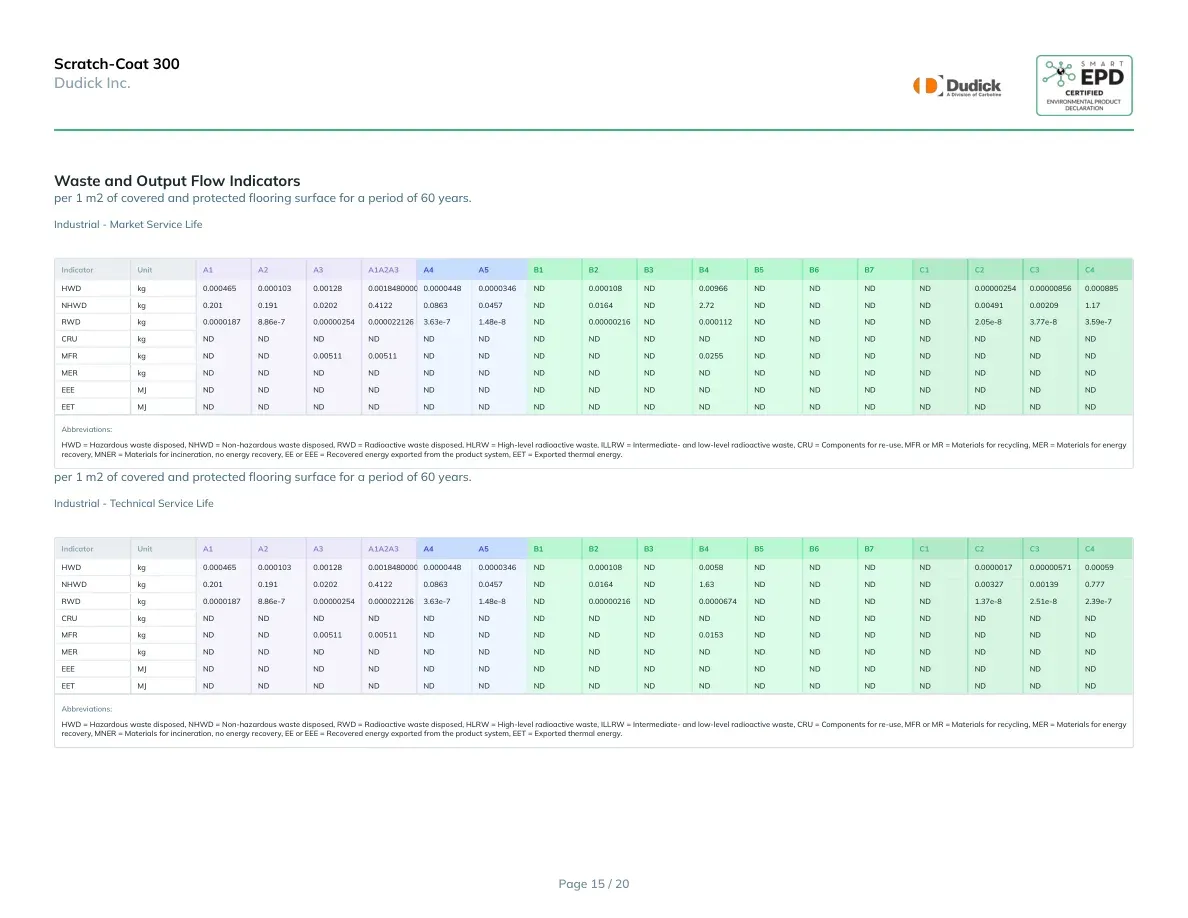
Scratch-Coat 300Dudick Inc.Waste and Output Flow Indicatorsper 1 m2 of covered and protected flooring surface for a period of 60 years.Industrial - Market Service LifeIndicatorUnitA1A2A3A1A2A3A4A5B1B2B3B4B5B6B7C1C2C3C4HWDkg0.0004650.0001030.001280.00184800000000000030.00004480.0000346ND0.000108ND0.00966NDNDNDND0.000002540.000008560.000885NHWDkg0.2010.1910.02020.41220.08630.0457ND0.0164ND2.72NDNDNDND0.004910.002091.17RWDkg0.00001878.86e-70.000002540.0000221263.63e-71.48e-8ND0.00000216ND0.000112NDNDNDND2.05e-83.77e-83.59e-7CRUkgNDNDNDNDNDNDNDNDNDNDNDNDNDNDNDNDNDMFRkgNDND0.005110.00511NDNDNDNDND0.0255NDNDNDNDNDNDNDMERkgNDNDNDNDNDNDNDNDNDNDNDNDNDNDNDNDNDEEEMJNDNDNDNDNDNDNDNDNDNDNDNDNDNDNDNDNDEETMJNDNDNDNDNDNDNDNDNDNDNDNDNDNDNDNDNDAbbreviations:HWD = Hazardous waste disposed, NHWD = Non-hazardous waste disposed, RWD = Radioactive waste disposed, HLRW = High-level radioactive waste, ILLRW = Intermediate- and low-level radioactive waste, CRU = Components for re-use, MFR or MR = Materials for recycling, MER = Materials for energy recovery, MNER = Materials for incineration, no energy recovery, EE or EEE = Recovered energy exported from the product system, EET = Exported thermal energy.per 1 m2 of covered and protected flooring surface for a period of 60 years.Industrial - Technical Service LifeIndicatorUnitA1A2A3A1A2A3A4A5B1B2B3B4B5B6B7C1C2C3C4HWDkg0.0004650.0001030.001280.00184800000000000030.00004480.0000346ND0.000108ND0.0058NDNDNDND0.00000170.000005710.00059NHWDkg0.2010.1910.02020.41220.08630.0457ND0.0164ND1.63NDNDNDND0.003270.001390.777RWDkg0.00001878.86e-70.000002540.0000221263.63e-71.48e-8ND0.00000216ND0.0000674NDNDNDND1.37e-82.51e-82.39e-7CRUkgNDNDNDNDNDNDNDNDNDNDNDNDNDNDNDNDNDMFRkgNDND0.005110.00511NDNDNDNDND0.0153NDNDNDNDNDNDNDMERkgNDNDNDNDNDNDNDNDNDNDNDNDNDNDNDNDNDEEEMJNDNDNDNDNDNDNDNDNDNDNDNDNDNDNDNDNDEETMJNDNDNDNDNDNDNDNDNDNDNDNDNDNDNDNDNDAbbreviations:HWD = Hazardous waste disposed, NHWD = Non-hazardous waste disposed, RWD = Radioactive waste disposed, HLRW = High-level radioactive waste, ILLRW = Intermediate- and low-level radioactive waste, CRU = Components for re-use, MFR or MR = Materials for recycling, MER = Materials for energy recovery, MNER = Materials for incineration, no energy recovery, EE or EEE = Recovered energy exported from the product system, EET = Exported thermal energy.Page 15 / 20
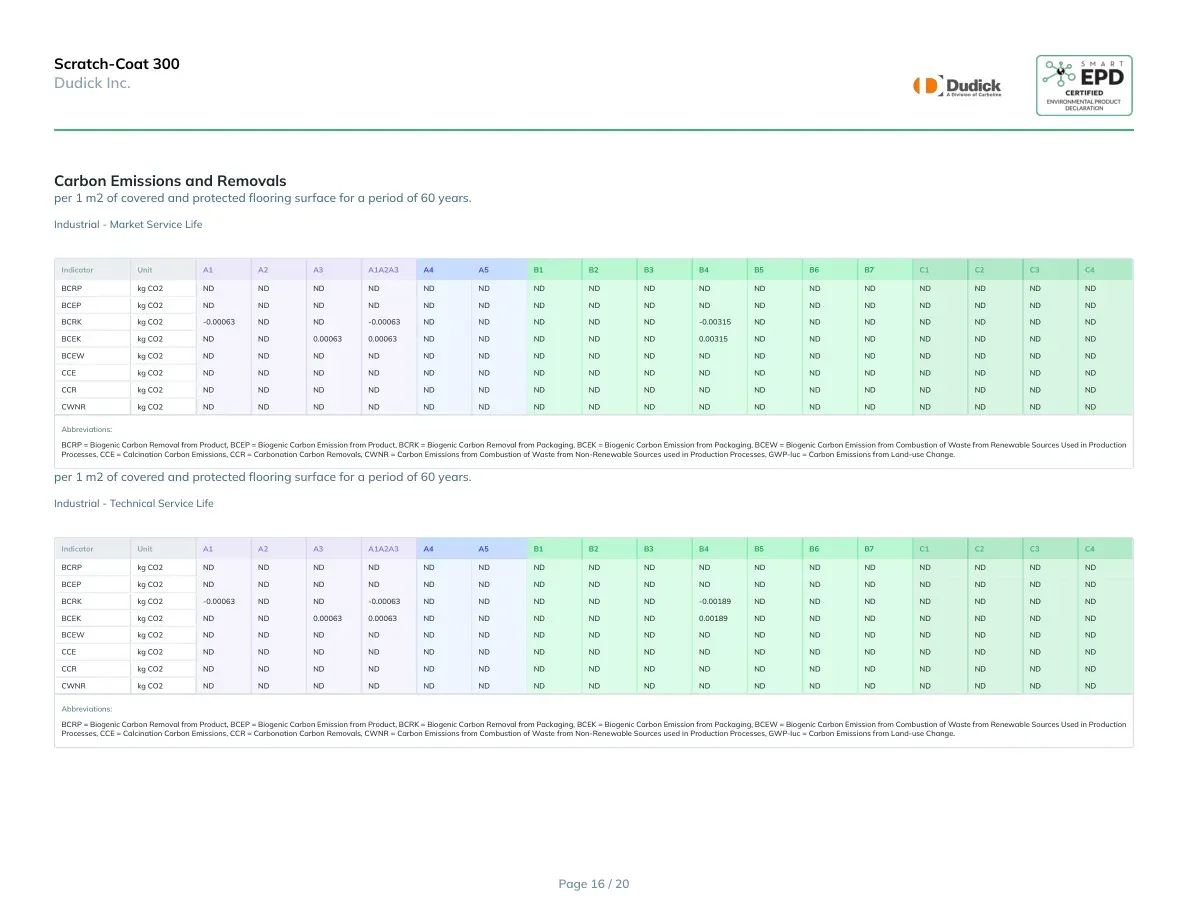
Scratch-Coat 300Dudick Inc.Carbon Emissions and Removalsper 1 m2 of covered and protected flooring surface for a period of 60 years.Industrial - Market Service LifeIndicatorUnitA1A2A3A1A2A3A4A5B1B2B3B4B5B6B7C1C2C3C4BCRPkg CO2NDNDNDNDNDNDNDNDNDNDNDNDNDNDNDNDNDBCEPkg CO2NDNDNDNDNDNDNDNDNDNDNDNDNDNDNDNDNDBCRKkg CO2-0.00063NDND-0.00063NDNDNDNDND-0.00315NDNDNDNDNDNDNDBCEKkg CO2NDND0.000630.00063NDNDNDNDND0.00315NDNDNDNDNDNDNDBCEWkg CO2NDNDNDNDNDNDNDNDNDNDNDNDNDNDNDNDNDCCEkg CO2NDNDNDNDNDNDNDNDNDNDNDNDNDNDNDNDNDCCRkg CO2NDNDNDNDNDNDNDNDNDNDNDNDNDNDNDNDNDCWNRkg CO2NDNDNDNDNDNDNDNDNDNDNDNDNDNDNDNDNDAbbreviations:BCRP = Biogenic Carbon Removal from Product, BCEP = Biogenic Carbon Emission from Product, BCRK = Biogenic Carbon Removal from Packaging, BCEK = Biogenic Carbon Emission from Packaging, BCEW = Biogenic Carbon Emission from Combustion of Waste from Renewable Sources Used in Production Processes, CCE = Calcination Carbon Emissions, CCR = Carbonation Carbon Removals, CWNR = Carbon Emissions from Combustion of Waste from Non-Renewable Sources used in Production Processes, GWP-luc = Carbon Emissions from Land-use Change.per 1 m2 of covered and protected flooring surface for a period of 60 years.Industrial - Technical Service LifeIndicatorUnitA1A2A3A1A2A3A4A5B1B2B3B4B5B6B7C1C2C3C4BCRPkg CO2NDNDNDNDNDNDNDNDNDNDNDNDNDNDNDNDNDBCEPkg CO2NDNDNDNDNDNDNDNDNDNDNDNDNDNDNDNDNDBCRKkg CO2-0.00063NDND-0.00063NDNDNDNDND-0.00189NDNDNDNDNDNDNDBCEKkg CO2NDND0.000630.00063NDNDNDNDND0.00189NDNDNDNDNDNDNDBCEWkg CO2NDNDNDNDNDNDNDNDNDNDNDNDNDNDNDNDNDCCEkg CO2NDNDNDNDNDNDNDNDNDNDNDNDNDNDNDNDNDCCRkg CO2NDNDNDNDNDNDNDNDNDNDNDNDNDNDNDNDNDCWNRkg CO2NDNDNDNDNDNDNDNDNDNDNDNDNDNDNDNDNDAbbreviations:BCRP = Biogenic Carbon Removal from Product, BCEP = Biogenic Carbon Emission from Product, BCRK = Biogenic Carbon Removal from Packaging, BCEK = Biogenic Carbon Emission from Packaging, BCEW = Biogenic Carbon Emission from Combustion of Waste from Renewable Sources Used in Production Processes, CCE = Calcination Carbon Emissions, CCR = Carbonation Carbon Removals, CWNR = Carbon Emissions from Combustion of Waste from Non-Renewable Sources used in Production Processes, GWP-luc = Carbon Emissions from Land-use Change.Page 16 / 20
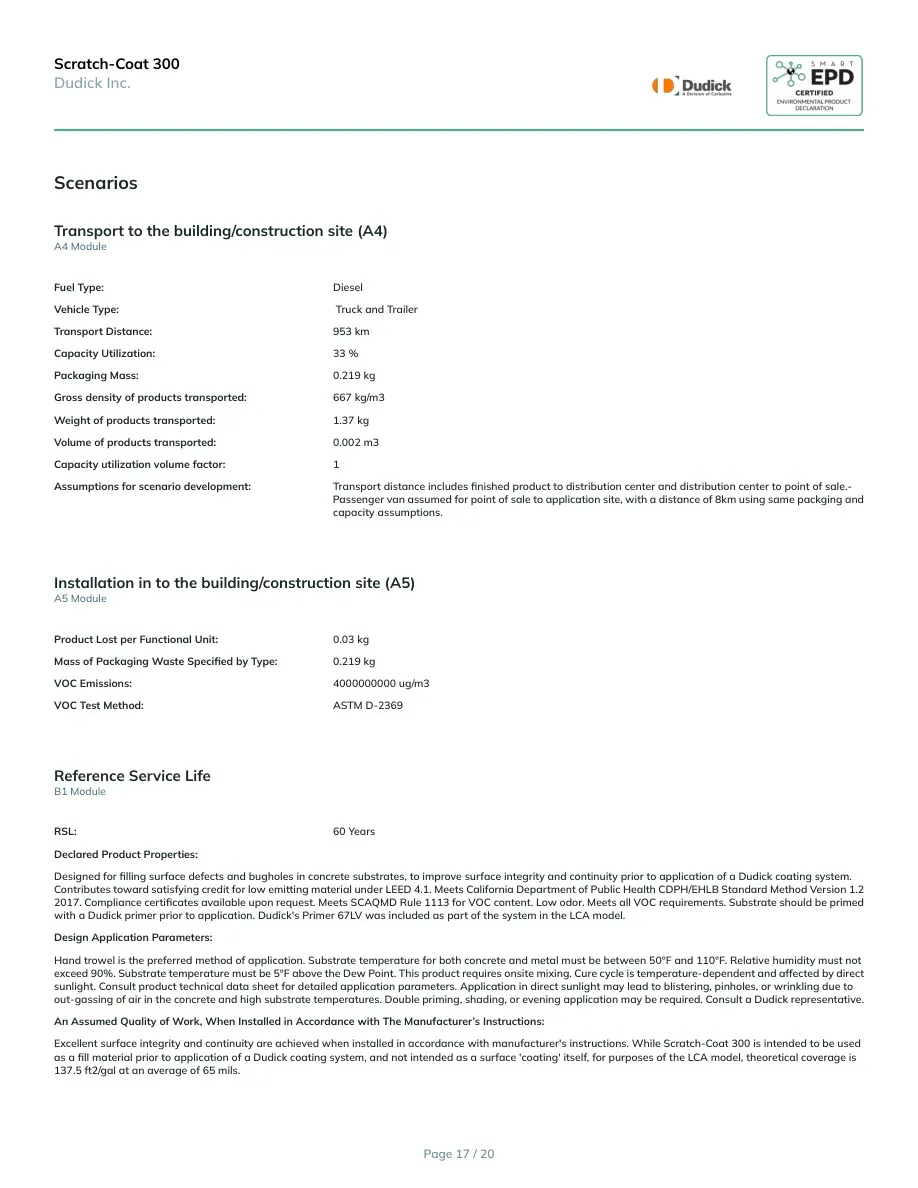
Scratch-Coat 300Dudick Inc.ScenariosTransport to the building/construction site (A4)A4 ModuleFuel Type:DieselVehicle Type: Truck and TrailerTransport Distance:953 kmCapacity Utilization:33 %Packaging Mass:0.219 kgGross density of products transported:667 kg/m3Weight of products transported:1.37 kgVolume of products transported:0.002 m3Capacity utilization volume factor:1Assumptions for scenario development:Transport distance includes finished product to distribution center and distribution center to point of sale.- Passenger van assumed for point of sale to application site, with a distance of 8km using same packging and capacity assumptions.Installation in to the building/construction site (A5)A5 ModuleProduct Lost per Functional Unit:0.03 kgMass of Packaging Waste Specified by Type:0.219 kgVOC Emissions:4000000000 ug/m3VOC Test Method:ASTM D-2369Reference Service LifeB1 ModuleRSL:60 YearsDeclared Product Properties:Designed for filling surface defects and bugholes in concrete substrates, to improve surface integrity and continuity prior to application of a Dudick coating system. Contributes toward satisfying credit for low emitting material under LEED 4.1. Meets California Department of Public Health CDPH/EHLB Standard Method Version 1.2 2017. Compliance certificates available upon request. Meets SCAQMD Rule 1113 for VOC content. Low odor. Meets all VOC requirements. Substrate should be primed with a Dudick primer prior to application. Dudick's Primer 67LV was included as part of the system in the LCA model.Design Application Parameters:Hand trowel is the preferred method of application. Substrate temperature for both concrete and metal must be between 50°F and 110°F. Relative humidity must not exceed 90%. Substrate temperature must be 5°F above the Dew Point. This product requires onsite mixing. Cure cycle is temperature-dependent and affected by direct sunlight. Consult product technical data sheet for detailed application parameters. Application in direct sunlight may lead to blistering, pinholes, or wrinkling due to out-gassing of air in the concrete and high substrate temperatures. Double priming, shading, or evening application may be required. Consult a Dudick representative.An Assumed Quality of Work, When Installed in Accordance with The Manufacturer’s Instructions:Excellent surface integrity and continuity are achieved when installed in accordance with manufacturer's instructions. While Scratch-Coat 300 is intended to be used as a fill material prior to application of a Dudick coating system, and not intended as a surface 'coating' itself, for purposes of the LCA model, theoretical coverage is 137.5 ft2/gal at an average of 65 mils.Page 17 / 20
Scratch-Coat 300Dudick Inc.Maintenance: Maintenance (B2)B2 ModuleMaintenance Cycle:60 Cycles/RSL60 Cycles/ESLMaintenance Process Information:Daily mopping with a cleaning solution such as Hillyard SM-1® Industrial Cleaner Degreaser, at a ratio of 1/2 cup cleaning solution to 1 gallon of mop water, is included as a required maintenance activity per the PCR. Since this product is intended as a surface defect filler underneath the bottom layer of the coating system, it technically does not require cleaning, however for purposes of the LCA model, maintenance cleaning was included.Replacement (B4)B4 ModuleReference Service Life:10 YearsReplacement Cycle:5 (ESL/RSL)-1Further assumptions for scenario development:Product is assumed to be applied in an industrial environment. A 10 year market service lifetime and a 15 year technical service lifetime was adopted in the LCA model. For the market service-based lifetime, one initial coating application and 5 recoats are required to maintain the average lifespan of a building, assumed to be 60 years. For the technical service-based lifetime, one initial coating application and 3 recoats are required to maintain the 60 year building lifespan.End of LifeC1 - C4 ModulesCollection ProcessCollected Separately:1.37 kgRecoveryLandfill:1.37 kgIncineration:0.027 kgDisposalProduct or Material for Final Disposal:1.37 kgAssumptions for scenario development:The US EPA WARM model was used to determine the processes used to dispose of waste materials, including packaging materials, scrap, hazardous waste, and unused product.Page 18 / 20
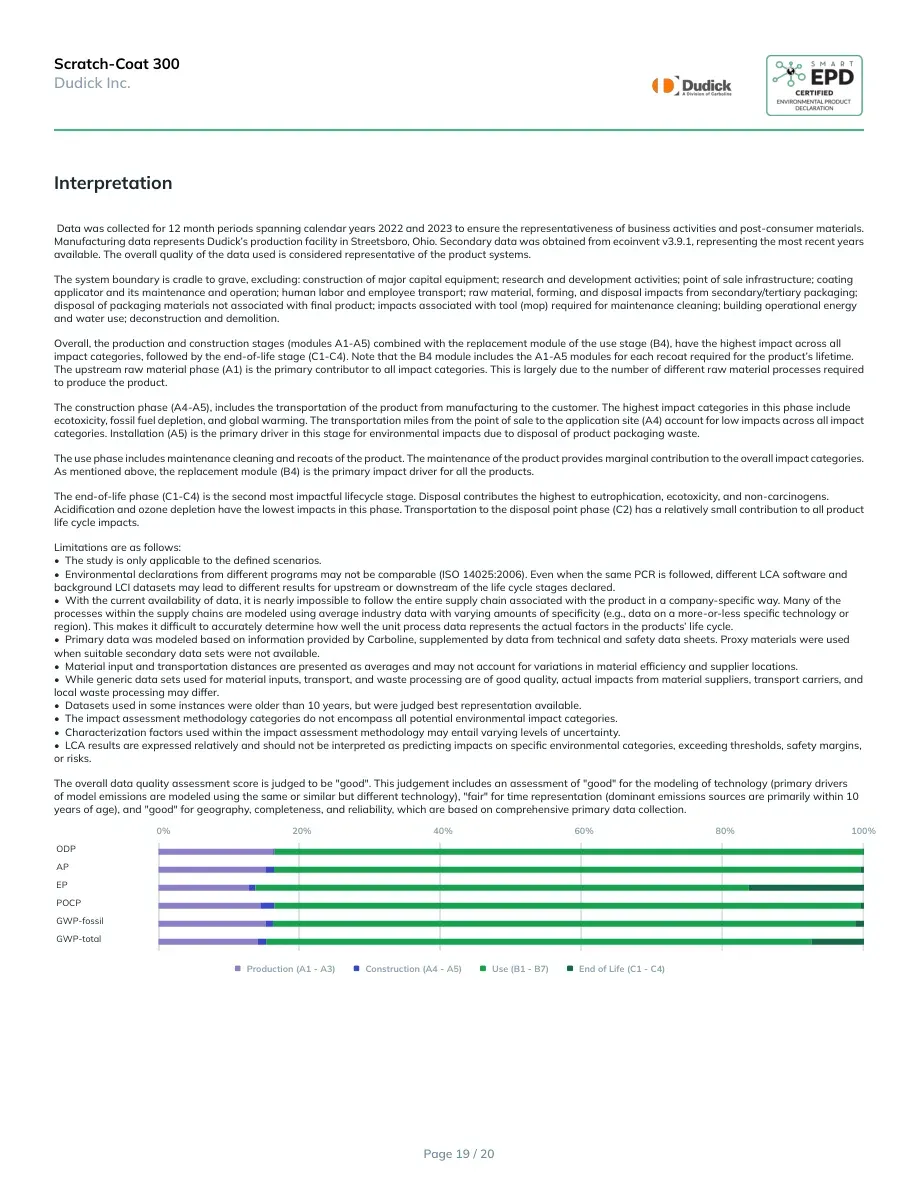
Scratch-Coat 300Dudick Inc.Interpretation Data was collected for 12 month periods spanning calendar years 2022 and 2023 to ensure the representativeness of business activities and post-consumer materials. Manufacturing data represents Dudick’s production facility in Streetsboro, Ohio. Secondary data was obtained from ecoinvent v3.9.1, representing the most recent years available. The overall quality of the data used is considered representative of the product systems.The system boundary is cradle to grave, excluding: construction of major capital equipment; research and development activities; point of sale infrastructure; coating applicator and its maintenance and operation; human labor and employee transport; raw material, forming, and disposal impacts from secondary/tertiary packaging; disposal of packaging materials not associated with final product; impacts associated with tool (mop) required for maintenance cleaning; building operational energy and water use; deconstruction and demolition.Overall, the production and construction stages (modules A1-A5) combined with the replacement module of the use stage (B4), have the highest impact across all impact categories, followed by the end-of-life stage (C1-C4). Note that the B4 module includes the A1-A5 modules for each recoat required for the product’s lifetime. The upstream raw material phase (A1) is the primary contributor to all impact categories. This is largely due to the number of different raw material processes required to produce the product.The construction phase (A4-A5), includes the transportation of the product from manufacturing to the customer. The highest impact categories in this phase include ecotoxicity, fossil fuel depletion, and global warming. The transportation miles from the point of sale to the application site (A4) account for low impacts across all impact categories. Installation (A5) is the primary driver in this stage for environmental impacts due to disposal of product packaging waste.The use phase includes maintenance cleaning and recoats of the product. The maintenance of the product provides marginal contribution to the overall impact categories. As mentioned above, the replacement module (B4) is the primary impact driver for all the products.The end-of-life phase (C1-C4) is the second most impactful lifecycle stage. Disposal contributes the highest to eutrophication, ecotoxicity, and non-carcinogens. Acidification and ozone depletion have the lowest impacts in this phase. Transportation to the disposal point phase (C2) has a relatively small contribution to all product life cycle impacts.Limitations are as follows: • The study is only applicable to the defined scenarios.• Environmental declarations from different programs may not be comparable (ISO 14025:2006). Even when the same PCR is followed, different LCA software and background LCI datasets may lead to different results for upstream or downstream of the life cycle stages declared.• With the current availability of data, it is nearly impossible to follow the entire supply chain associated with the product in a company-specific way. Many of the processes within the supply chains are modeled using average industry data with varying amounts of specificity (e.g., data on a more-or-less specific technology or region). This makes it difficult to accurately determine how well the unit process data represents the actual factors in the products’ life cycle.• Primary data was modeled based on information provided by Carboline, supplemented by data from technical and safety data sheets. Proxy materials were used when suitable secondary data sets were not available.• Material input and transportation distances are presented as averages and may not account for variations in material efficiency and supplier locations.• While generic data sets used for material inputs, transport, and waste processing are of good quality, actual impacts from material suppliers, transport carriers, and local waste processing may differ.• Datasets used in some instances were older than 10 years, but were judged best representation available.• The impact assessment methodology categories do not encompass all potential environmental impact categories.• Characterization factors used within the impact assessment methodology may entail varying levels of uncertainty.• LCA results are expressed relatively and should not be interpreted as predicting impacts on specific environmental categories, exceeding thresholds, safety margins, or risks.The overall data quality assessment score is judged to be "good". This judgement includes an assessment of "good" for the modeling of technology (primary drivers of model emissions are modeled using the same or similar but different technology), "fair" for time representation (dominant emissions sources are primarily within 10 years of age), and "good" for geography, completeness, and reliability, which are based on comprehensive primary data collection. 0%20%40%60%80%100% ODP AP EP POCP GWP-fossil GWP-total Production (A1 - A3)Construction (A4 - A5)Use (B1 - B7)End of Life (C1 - C4)Page 19 / 20
Scratch-Coat 300Dudick Inc.Additional Environmental Information Before using this product, it is recommended that the operator read and follow all caution statements on the product data sheet and on the SDS for this product, and personal protective equipment must be used as directed. References [1] ISO 14040/Amd1:2020: Environmental management - Life cycle assessment - principles and frameworks.[2] ISO 14044/Amd1:2017/Amd2:2020: Environmental management - Life cycle assessment - Requirements and guidelines.[3] ISO 21930:2017, “Sustainability in buildings and civil engineering works - Core rules for environmental product declarations of construction products and services”.[4] NSF International, Product Category Rule for Environmental Product Declarations for Resinous Floor Coatings, December 2018.[5] ISO 14025:2006, “Environmental labels and declarations - Type III environmental declarations - Principles and procedures”.[6] Bare, J. 2014. Tool for the Reduction and Assessment of Chemical and Other Environmental Impacts (TRACI) TRACI version 2.1 User’s Guide. US EPA Office of Research and Development, Washington, DC, EPA/600/R-12/554, http://nepis.epa.gov/Adobe/PDF/P100HN53.pdf[7] IPCC, 2013: Climate Change 2013: The Physical Science Basis. Contribution of Working Group I to the Fifth Assessment Report of the Intergovernmental Panel on Climate Change [Stocker, T.F., D. Qin, G.-K. Plattner, M. Tignor, S.K. Allen, J. Boschung, A. Nauels, Y. Xia, V. Bex and P.M. Midgley (eds.)]. Cambridge University Press, Cambridge, United Kingdom and New York, NY, USA, 1535 pp. https://www.ipcc.ch/report/ar5/wg1/[8] ecoinvent v3.9.1, December 2022, https://ecoinvent.org/the-ecoinvent-database/data-releases/ecoinvent-3-9-1/[9] US Environmental Protection Agency Waste Reduction Model (WARM) v15, September 2022, https://www.epa.gov/warm/versions-waste-reduction-mod-el-warm#15[10] Ryberg, M., M. Vieira, M. Zgola, et al. Updated US and Canadian Normalization Factors for TRACI 2.1. CLEAN TECHNOLOGIES ENVIRONMENTAL POLICY. Springer, New York, NY, 16(2):329-339 (2014). http://dx.doi.org/10.1007/s10098-013-0629-z[11] Weidema B. P., C. Bauer, R. Hischier, et al. Overview and methodology. Data quality guideline for the ecoinvent database version 3. Ecoinvent Report 1(v3), St. Gallen: The ecoinvent Centre (2013). https://ecoinvent.org/wp-content/uploads/2021/09/dataqualityguideline_ecoinvent_3_20130506.pdf[12] Facts and figures about materials, waste and recycling (2018). https://www.epa.gov/facts-and-figures-about-materials-waste-and-recycling. Page 20 / 20
